
The controls worked, the fraud was stopped, and the losses were limited.
Then came the board meeting and the question nobody had prepared for: prove it.
The board expected the company to prove that the fraud was serious, the response was structured, controls were validated before deployment, and the institution had visibility of the threat at the earliest possible point with a documented record of all of it that can withstand a regulatory examination.
For most financial institutions, that question lands like a second incident. The fraud team did everything right. But the documentation trail, the timestamps, the validation records, and the deployment confirmations were assembled after the fact, from partial records, across systems that were never designed to produce a coherent audit trail.
The fraud had been stopped, but the story of how it had been stopped was considerably harder to tell.
The Second Problem Nobody Talks About
The financial fraud conversation in Africa, and globally, is almost entirely focused on detection and prevention. As a financial institution, how do you demonstrate that your fraud response was structured? How do you show a regulatory examiner that controls were validated before deployment, not rushed in under pressure? How do you account, in a vendor risk review, for what its technology partner did, and what evidence exists to support that account?
Most infrastructure providers communicate about incidents reactively: a summary after the fact, a description of what was detected, occasionally an apology for the disruption. The structured evidence chain that the downstream obligations require, the timeline, the validation record, the deployment documentation, and the outcome data typically does not exist in a form that institutions can use directly.
The compliance burden falls on the institution itself, reconstructed from incomplete records, often by teams that were not involved in the original response. It is an invisible tax on fraud governance, and it is paid every time an incident closes without adequate documentation.
What a Communication Protocol Actually Does
For a company like Qore, their incident communication is a governance infrastructure designed to produce, in real time and during the response, the documentation that regulated institutions need to meet their downstream accountability obligations.
The protocol runs in four stages; each aligned to a specific accountability requirement.
Stage 1: The first notification goes out before the full picture of the fraud scheme; before Qore has finished mapping how it works, what it targets, and how far it has spread. Under the CBN’s 2024 Risk-Based Cybersecurity Framework, the timing of risk awareness is a material accountability factor. The early notification creates that timestamp.
Stage 2: Once the pattern has been validated through Qore’s governance checkpoints, institutions receive a structured typology briefing, not a technical summary for the security team, but a document written to be read by a board risk committee or a regulatory examiner without requiring translation.
Stage 3: Following conrtrol deployment, institutions receive a confirmation document that closes the accountability loop: what was deployed, when, against which validated fraud pattern, and with what evidence base. This document provides the audit trail that the CBN’s Cybersecurity Framework and vendor risk management standards require.
Stage 4: After deployment, Qore provides ongoing monitoring data that allows institutions to track the sustained effectiveness of controls over time. This post-deployment reporting serves a dual purpose: it enables institutions to demonstrate sustained risk mitigation to boards and regulators, and it gives Qore the feedback loop required to refine controls as fraud patterns evolve.
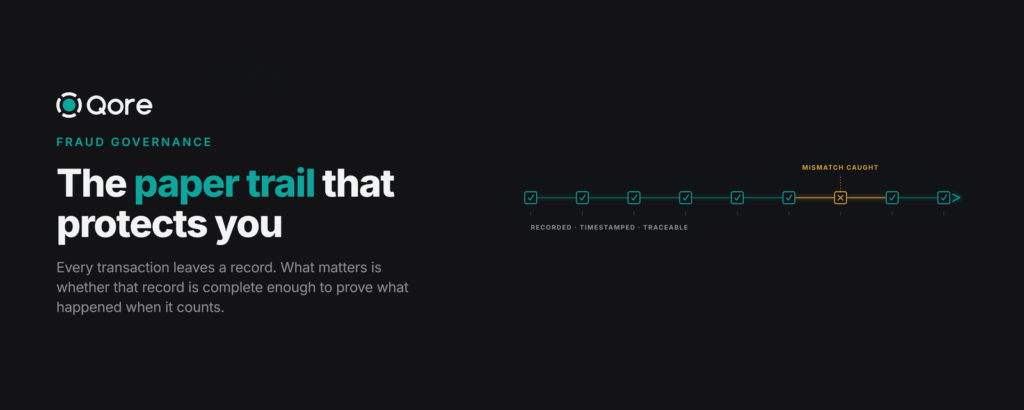
Each stage produces a document. The documents are designed to fit together into a single evidence package. That package is what a CISO can put in front of a board risk committee, a compliance officer can submit alongside a regulatory notification, and a risk team can present in a vendor review without additional preparation.
What Board Ready Actually Means
The phrase gets used loosely. In the infrastructure industry, “board-ready” often means a slide deck with a pie chart and a reassuring headline about detection rates.
For Qore’s clients, it means something more specific: a documentation package that a CISO, CRO, or COO can place in front of a board risk committee or regulatory examiner and have it withstand the questions that follow.
Those questions, in a serious board risk conversation, look like this: When did you first have visibility of this risk? What evidence exists that the controls deployed were validated before going live? What was the customer’s impact on the response? Specifically, what was the false positive rate, and how do you know? And how do you know the improvement has been made?
The CBN’s Risk-Based Cybersecurity Framework is explicit about what it expects institutions to maintain: records of threat intelligence operations, control validation processes, and incident response activities. For institutions whose technology partners cannot produce this documentation, the burden of building it falls internally often on teams that had no direct involvement in the response, working backward from incomplete information.
Why is This Becoming a Competitive Divide
The World Bank’s research on fast payment fraud reaches a parallel conclusion: the institutions most vulnerable to coordinated fraud are not those with the weakest detection capability. They are those whose response infrastructure, including the documentation of it, cannot move at the pace the threat demands.
In Nigeria, where NIBSS recorded N52.26 billion in fraud losses in 2024 and instant payment volumes exceeded N1 quadrillion, the pace of that evolution is not theoretical. The attack surface is expanding faster than most institutional governance frameworks were designed to track.
What Qore’s incident communication protocol represents, in this environment, is a specific answer to a specific question that regulators and boards are beginning to ask more directly: not just whether your infrastructure provider can stop fraud, but whether it can prove that it did — in a form that your institution can actually use.
The CISO who can walk into a board meeting with a complete evidence package is not just better prepared for the conversation. They are in a fundamentally different position with respect to regulatory accountability, vendor risk management, and board confidence.
That position is what Qore’s incident communication protocol is designed to create. Not after the fact. During the response, in real time, as a structural feature of how the governance model operates so that when the board meeting comes, the story of what happened is already documented, already organised, and already ready to be told.
Because in fraud governance, the institutions that will build lasting confidence are not those that can claim the best outcomes. They are those that can prove them.
References
International Monetary Fund (2026). The Rise of Cyber Events and Digital Fraud in the Financial Sector. The Rise of Cyber Events and Digital Fraud in the Financial Sector
World Bank (2023). Fraud Risks in Fast Payments. fastpayments.worldbank.org/sites/default/files/2023-10/Fraud in Fast Payments_Final.pdf
Basel Committee on Banking Supervision (2023). Digital Fraud and Banking: Supervisory and Financial Stability Implications. bis.org/fsi/fsisummaries/exsum_23902.pdf
European Central Bank & European Banking Authority (2022–2024). Payment Fraud and Security Reporting.
Build Tomorrow, Today
Let’s discuss how our products can give your business the boost it needs.