
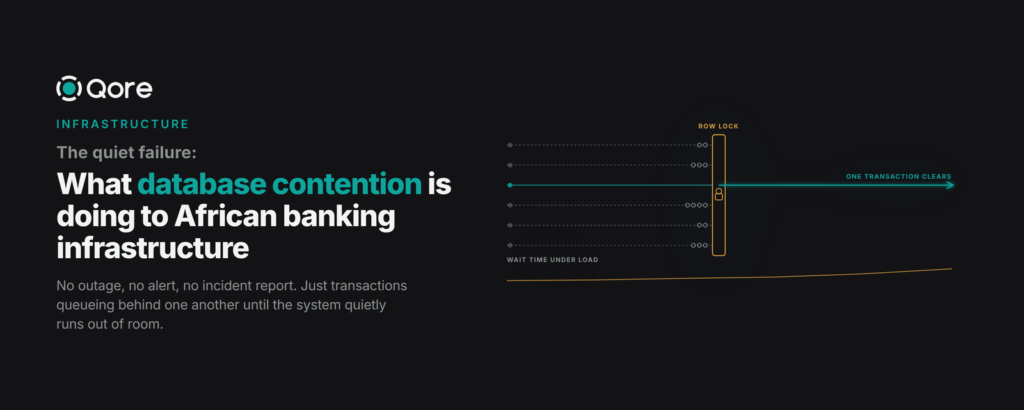
There is nothing unusual Monday mornings as these are peak period for most Nigerian financial institutions; it’s a period when weekend backlogs clear and salary-related transfers process simultaneously across millions of accounts. A bank’s system can handle the load until it cannot.
A bank’s syetem queitly begins to fail when they begin to see a decrease in response time; transactions begin to queue up, and customer-facing channels began returning errors. By the time the bank’s operations team identifies the cause of this issue, it is too late and customers are already affected. Customers would have already called, complaints would have been logged and somewhere in a risk report that would reach the board the following month, a performance incident will be recorded that nobody had predicted, and nobody had been able to prevent it in time.
This scenario, with variations in timing and severity, is playing out with increasing frequency across African financial institutions as digital transaction volumes scale faster than the infrastructure frameworks designed to manage them.
Why Database Contention?
Database contention occurs when multiple processes compete simultaneously for the same database resources – locks, memory, processing threads, and I/O capacity. In a single-institution environment, contention is manageable: traffic can be predicted, resources can be allocated, and peak periods can be planned for.
Shared infrastructure creates two things simultaneously: the network intelligence advantage that no single institution can replicate alone, and a performance interdependency that requires disciplined isolation controls to manage. The difference between the two outcomes is governance. When several institutions experience peak demand simultaneously, they are not just competing with their own transaction volumes. They are competing with every other institution on the same rails.
The growth of digital financial services in Africa has made this problem more acute. Nigeria’s instant payment transactions through NIBSS exceeded N1 quadrillion in 2024, across billions of individual transfers. The Central Bank of Nigeria’s drive toward a cashless economy has accelerated the shift of transaction volumes to digital channels faster than infrastructure investment has kept pace in many institutions. More transactions, processed through the same shared layers, at the same peak moments, create more frequent and more severe contention events.
The EFInA Access to Financial Services in Nigeria survey consistently documents the growth of digital transaction adoption, particularly among previously underserved populations. Each new digital banking customer onboarded adds to the peak-period load, and the infrastructure that performed adequately at one volume threshold may behave very differently at two or three times that volume.
Why Database Contention Is Hard to See Coming
Database contention does not appear on a dashboard as a red alert. It appears as latency transactions that take slightly longer than usual, then slightly longer still, then it begins to queue, then it is failing.
The insidious quality of contention is that by the time it is visible as a performance problem, it is already a customer experience problem. The window between early signal and visible disruption is narrow, and without real-time monitoring specifically designed to detect contention at the infrastructure layer, most institutions are responding to symptoms rather than causes.
In a shared environment, the diagnostic challenge is compounded. An institution experiencing degraded performance may not immediately be able to determine whether the cause is internal to a spike in their own transaction volumes or external, driven by contention from activity elsewhere on the shared infrastructure. The distinction matters enormously for both the response and the remediation. But without visibility into the infrastructure layer, institutions are left to infer rather than diagnose.
The Scale of the Problem Across Africa
Nigeria is not alone in this. Across sub-Saharan Africa, the expansion of mobile money, agency banking, and real-time payment infrastructure has created similar dynamics in markets where digital financial service adoption is outpacing infrastructure maturity.
Digital payment volumes are growing at rates that significantly outpace the underlying technology investment of many financial institutions, particularly smaller and mid-tier banks that rely heavily on third-party core banking infrastructure providers.
When shared infrastructure experiences performance failures during peak periods, the impact is not contained to a single institution. It ripples across every institution on that infrastructure, at exactly the moment when the system is under the most stress.
This is the specific risk that database contention represents at scale: a performance failure that, in a shared environment, is simultaneously a systemic risk event.
What Needs to Change
The conversation about database contention in African banking infrastructure needs to move from reactive to structural. Three changes are necessary.
First, performance isolation needs to become a design standard, not an optional feature. Shared infrastructure providers must architect their systems so that peak demand from one institution cannot degrade performance for others. This requires workload separation at the database layer a technical decision that has significant cost and architectural implications, but that represents the baseline expectation for infrastructure that financial institutions depend on for real-time operations.
Second, real-time contention monitoring needs to be a standard operating procedure. The early signals of contention latency spikes, lock wait increase and I/O queue growth are detectable before they escalate into customer-visible disruptions. Infrastructure providers that surface these signals in real time, with the governance trail that documents detection and response, give their client institutions the proactive posture that regulators increasingly expect.
Third, the documentation standard needs to be increased. When contention events occur, the evidence chain about what was detected, when, what was done, and what the outcome was, need to be structured to meet the evidence requirements of the CBN framework and the reporting expectations of board risk committees. Infrastructure providers that cannot produce this documentation leave their client institutions to reconstruct incident records after the fact, from incomplete sources, under regulatory and board pressure.
The Standard Is Being Built
Some infrastructure providers operating in the African market are beginning to treat performance isolation, contention monitoring, and remediation documentation as core governance obligations rather than technical nice-to-haves.
Qore, a banking-as-a-platform provider powering more than 500 financial institutions across Africa, has built its operational model around this principle. Qore maintains performance isolation across its shared environment, runs real-time contention monitoring as a standing infrastructure layer, and documents its remediation trail to CBN framework standards making that evidence available to client institutions for their own board and regulatory reporting.
The approach reflects a broader principle that the most credible infrastructure providers in Africa’s financial sector are beginning to articulate reliability is not the absence of incidents. It is the presence of governance to the documented, auditable record of what was detected, what was fixed, and what was built to prevent recurrence.
For African financial institutions evaluating their infrastructure partnerships, that governance record is increasingly the question worth asking. Not just whether your provider has experienced performance issues every provider at scale has but whether they can show you, with evidence, what they did about it.
References
- Nigeria Inter-Bank Settlement System (NIBSS), Annual Report 2024. Instant payment transaction volumes exceeding N1 quadrillion.
- Central Bank of Nigeria, Risk-Based Cybersecurity Framework and Guidelines for DMBs and PSBs, issued 31 May 2024, effective 1 July 2024. https://gelias.com/images/Newsletter/_Overview_of_the_CBN_Risk-Based_Cyber_Security_Framework.pdf
- EFInA, Access to Financial Services in Nigeria Survey, 2023. https://a2f.ng/wp-content/uploads/2024/07/A2F-2023-SURVEY-REPORT-1.pdf
- World Bank, Financial Inclusion Global Initiative. Infrastructure investment gap in African digital payments markets. https://www.worldbank.org/en/publication/globalfindex https://dpi.africa.com/siips-2024-tracking-africas-growth-in-digital-payment-inclusion/
- CBN, Guidelines on Operational Risk Management for Financial Institutions, 2023.
- BIS/FSI, Supervisory Implications of Digital Innovation in Banking, 2024
Build Tomorrow, Today
Let’s discuss how our products can give your business the boost it needs.